
Hobbies
Finding new things to do while retired

Everyone knows that staying active at all stages of life is key to good health. Playing with friends and going to school keeps us in the flow as kids and young adults. We finish school and find a career (or at least a series of jobs) that hopefully keep our minds occupied. Then we finally get to the stage where we can leave our job and relax - no more waking up to an alarm clock, no more traveling with the masses in rush hour traffic, no more aggravating boss and co-workers. We retire! But now what?
Do a Google search on “why stay active during retirement” and you will find the same things over and over again:
The health benefits of staying active and social as you age are hard to ignore. From lowering your risk of depression and enhancing your social wellbeing to improving strength and stamina – there are a lot of good reasons to keep moving and stay well connected with friends.
I’ve been retired for almost 15 month. I did have a small part-time job doing an afternoon science club with elementary school kids. I liked the job for about a month, then it got to be complete drudgery. I was suppose to be teaching basic science concepts to kids ages 5-8, but all they wanted to do was run around, talk, and play. I lasted about six months until I couldn’t take it anymore and quit.
So instead of working I’ve been doing a variety of different thing to keep busy. I’ve written posts on bike riding, fishing, camping, and photography in the past year. What else can I get involved in to stay mentally alert and physically fit? Well, here are some things I’ve been doing lately to stay active and alive.
Pickleball
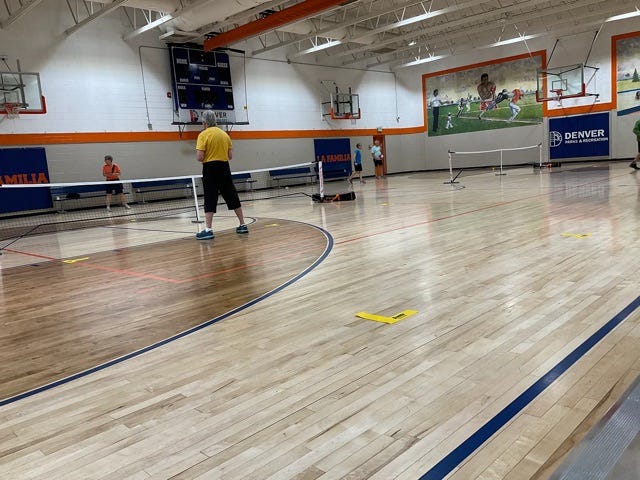
A game only for old people? If that’s what you think then you don’t know nothin’. People of all ages, athletic abilities, shapes, and sizes seem to be playing the game, at least on the courts near my house. There was even a woman who had a small portable oxygen tank playing a game. USA Pickleball, the official organization, has an 84 page guidebook that explains all the rules. but let’s just cut to the chase here … in a nutshell, here is what I’ve learned in my playing experience (about 4 months now):
although the game can be played with just two people (singles), four is much easier and more fun
A solid paddle is used to strike a plastic ball with holes in it (like a whiffle ball) over the net of a court on a court about half the size of a tennis court
Scoring is a bit confusing. The score is announced before each serve in this order: the score of the serving team, the score of the team being served to and a number to designate the person serving (either 1 or 2). On the first service of the game only one person on the team that starts gets to serve. On the serve and next two shots the ball has to hit the ground before it is returned. After that it can be played in mid-air or on one bounce. The game can be played at whatever pace the players decide. Some people are happy to gently volley back and forth, while others play to slam the ball with the intent to kill. The contest ends at 11 points, with the winning team ahead by at least two.
We’ve become regulars at the outdoor court on Sunday mornings, and at one of the rec centers in Denver on Mondays. The people who show up on Sunday have been playing for several years, and they usually play much better than me (meaning I usually lose the games I play against them). The Monday gang are more my speed and ability (meaning I sometimes win a game or two). All in all the game is a lot of fun and it gets me out of the house and moving around.
Parting advice - You really should try it, it’s a fun game.
Quilting


My mother was a professional seamstress for her entire life. She tried to teach me how to sew, but I was too busy playing stickball or watching The Munsters to pay attention. She even bought me a sewing machine about 30 years ago that I think she used more than I ever did. That machine was a casualty of Superstorm Sandy. Recently I purchased another sewing machine, mainly to make window coverings for my van. Once those projects were done, I came up with other things that were “must haves” for any camper van:
A bag to hold my mattress pad (so it looks like a bolster on the back seat)
A seat-back map holder
A ceiling fan cover
A pad to dampen noise from the vibrating stove


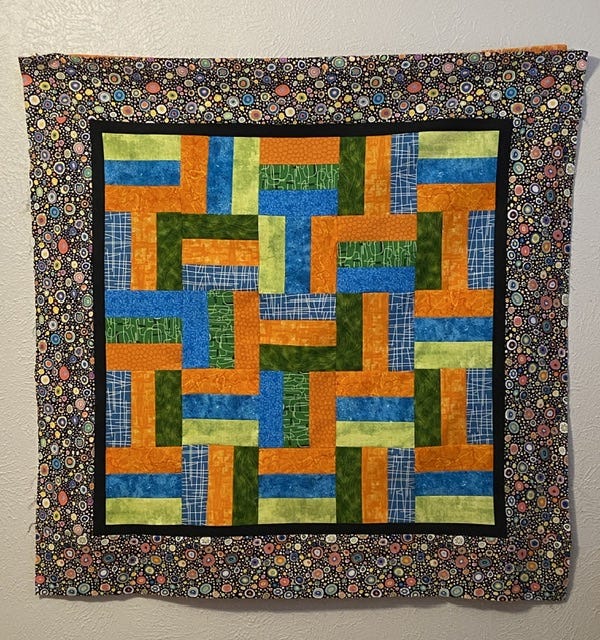
Now the van is only 18 feet long, and there are only so many things I could make with my fabulous new sewing machine, and I’d run out of ideas. So I decided to sign up for a beginner quilting class. Mind you, I have a very hard time cutting fabric straight and sewing straight lines. So was quilting a good use of my time and money? Well, it just so happens that quilters have tools that make it almost foolproof to cut straight lines - they use rotary cutters, not scissors, to cut the fabric, big plastic rulers (some have to get sprayed with anti-slip stuff, others that are made with an anti-slip coating) to hold on the fabric to set the cut line, and cutting mats that are called “self healing” because they don’t show cut marks.
Today at class I used my tools and successfully cut several pieces of fabric. I can now say (with the aid of those tools) non-straight cuts may be a thing of the past (I can only hope!) But sewing straight lines? As far as I learned during class, the only tool for this is our eye. But there are also some non-tools that come into play. Like paying attention. And sewing slowly. And carefully. And having the patience to rip out seams that are crooked or too wide. I tried really hard to do all those things - sew slowly and carefully while paying attention to where the fabric was in relation to the markings on the machine. I can’t say that every seam was correct, in fact I did have my share of seams that had to be ripped out and redone.
When I told a friend that I was making a quilt, her response was, “you’re becoming an old lady”. It is true I need my reading glasses when I try to read a pattern and my back aches after sitting and sewing for a few hours. But quilting requires concentration, precision, and attention to detail that keeps a person’s brain working. So if I am becoming an old lady because of this new endeavor, at least it’s helping me remember what day it is and which planet I’m on.
Parting advice - it’s a fun and creative hobby that’s not just for old ladies
Joining a Chorus

I sing in the shower. I sing in the car. Whenever I’m involved in those other hobbies I’ve listed above, I’m listing to music and singing along. I think I sound ok to be singing in my own company, but I doubt I’m ready for a solo performance on stage. I never sang in a group at school or thought about joining a chorus. But then a friend suggested I join Sage Singers, the only senior LGBTQ+ in the country (and maybe the world). I’ve been singing with Sage since January and it’s been a lot of fun. I started in the tenor section, mainly because that’s were they told me to sit. Once one of the experienced members heard me, I got booted from that group. Luckily the tenors took me in with open arms. I really like sitting with the guys in this group. During practice I position myself near some of the stronger voices and listen to them as I attempt to match the notes they are singing.
There are so many talented people in the chorus. Many of them have been singing in choral groups for a long time. They can also play an instrument and read music. I cannot do any of these things. Sage Singers gets me out of the house every Sunday afternoon for our two hour practice session. The chorus puts on three concerts per season, which runs from September to June. This past March I sang in the show, which was an absolute blast. The program featured Broadway show tunes, songs that were catchy and upbeat. This coming season the chorus will again have three performances. Because of travel plans made a year ago, I’ll be able to make only two of these. And next year is the extravaganza called GALA Choruses Festival, which I plan on attending.
What is Festival 2024?
GALA Choruses signature event is our quadrennial Festival, which gathers LGBTQ+ choruses from all over North America and the world. Festival is five days of singing, connecting, and creating. It’s wall-to-wall concerts, workshops, social events, joy and pride. It’s the largest LGBTQ choral event in the world. GALA Choruses Festival celebrates more than 15,000 singers representing nearly 200 LGBTQ* choruses in North America and beyond. Festival 2024 choirs will perform at world-class venues in downtown Minneapolis including Orchestra Hall, The Minneapolis Convention Center, and Central Lutheran Church. 1
Going to GALA will be an adventure. Many of the people in the chorus have talked about going to previous festivals and how great the experience was. While in Minneapolis I’ll have chance to listen to some great music and also connect with some friends who live there. And maybe I can convince them to come to the Sage Singers performance and wow them with my fabulous voice!
Parting advice - singing is fun and being in a group can disguise an off-key voice like mine!
And furthermore:
My book recommendation: Iona Iverson’s Rules for Commuting by Clare Pooley. I got it from my local library. It’s a quick, fun read. Another book by Pooley is The Authenticity Project, which was also a light entertaining read.
My podcast recommendation: The Hidden Brain, find it using a podcast app like Google Podcasts or at the website https://hiddenbrain.org . Interesting topics every week, this weeks episode is on the secret to great team.
My music recommendation: check out the band Michelle at the website https://www.wearemichelle.com/#block-views-block-videos-block-4. Click on the word VIDEO at the top of the screen. Here you can listen to a few of their songs off the album After Dinner We Talk Dreams.
Festival 2024, https://galachoruses.org/festival-2024/
Thanks for the comments and the podcast recommendation. I’ve downloaded it and will listen to it soon.
Excellent colors selected on your quilt. I won’t mind trying to make one when i too retire. A recommendation for podcast is “No Stupid Questions”, pretty sure you will like this one. :)