
Tattle Tale
Why Kids Tattle and Adults Refuse To Talk

There is an National Public Radio show I’ve been listening for at least 20 years. It’s called This American Life. If you never heard it you should give it a listen. Stories about everyday people in regular and irregular situations are told weekly. As their website says:
This American Life is a weekly public radio program and podcast. Each week we choose a theme and put together different kinds of stories on that theme.
This morning I was listening to the latest episode from June 10th titled, “Not Fair”. The first story deals with kindergarten students who spend much of the day tattling on one another. Young children are rule followers and feel the need to report when someone doesn’t adhere to those rules. I’m a teacher in a middle school. During my teaching career I’ve observed that by 6th grade (it may be sooner than this, I don’t know), tattling is no longer a thing kids do. Many of them still follow rules, but the ones who don’t are rarely thrown under the bus by their peers. The only time one student has told on another is when a personal possession, such as a pencil or a book, is taken. If one kid hits another, the puncher is never revealed by the punchee (I know that isn’t a word, but it’s how I’ll refer to the recipient of the hit). Why does our mindset of always seeking justice, reporting what occurred, and fingering the perpetrator change as we get older? Why are we so interested in doing this at a young age? Why is tattling against social norms as we get older?
Children tend to be very rigid when it comes to rules. Many see those rules as either right or wrong, with no grey area in between, and they will report the rule infractions. This is why teachers of very young children say they spend much of their day dealing with students tattling on one another. Children may also report rule breakers because they are jealous, they want to get someone in trouble, they are seeking attention, or they want to show they know the rules. Young children involve an adult more often when an incident occurs because they haven’t developed the interpersonal problem solving skills necessary to deal the problem on their own.
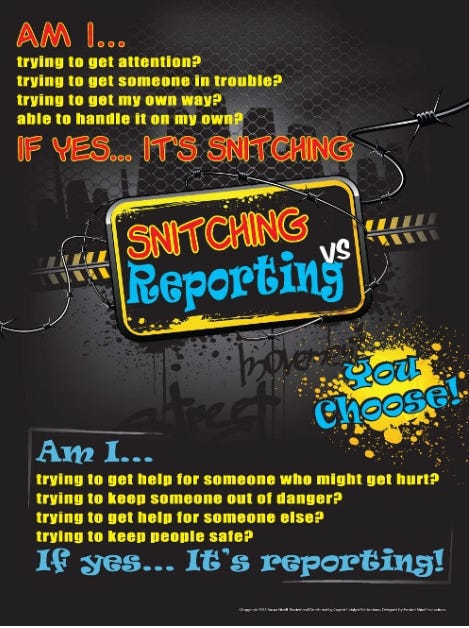
Children are encourage to stop tattling, and instead report. A book called Snitchy Witch1 by Frank J. Sileo, Ph.D. explains the difference between these two. When someone is tattling, they are referring to an incident that is not harmful to either party and doesn’t really require adult intervention. For example, if I were a 1st grader and my best friend just told me my hair was ugly, I shouldn’t tattle on her to my teacher. Yes, my feeling may have been hurt by the insensitive comment my friend made, but she did not harm me (yes, the old adage, “Sticks and stones may break my bones, but names will never harm me”, comes into play here). But if my friend hauled off and punched me because she thought my hair was ugly, well then, I should report this straight away to an adult. Children need to be taught the difference between more dangerous situations that can end up in bullying or physical harm, and those that are less harmful and lead to hurt feelings or frustration.
So when do we go from tattling about every little rule infraction to never wanting to snitch on someone? For example, on a dare your friend pulls the fire alarm in school. You hear about it but never tell anyone who was at fault for disrupted the school day. Isn’t this breaking the rules? Well, yes, but tell someone what you know? No way!
There are many reasons why people don’t speak up when they know about a rule infraction as they get older. These are:
Fear of retribution from a bully
Pressure from cliques in you community
Not knowing what to do or how to react
Fear of being labeled as a snitch
Feeling it is none of their business and that it’s just better to stay uninvolved
Feeling it’s the fault of the victim
Feeling that even if a report is made, adults or those in power will do nothing to fix the situation
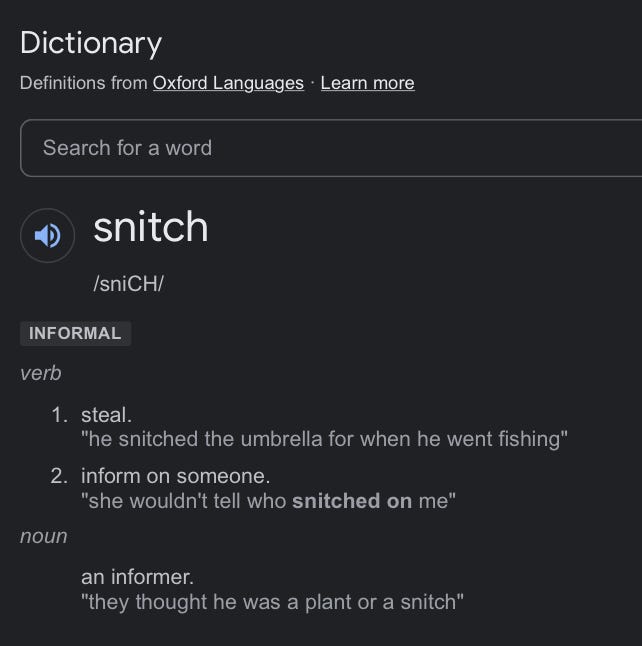
In corporate America, “snitching” on a fellow employee is seen as a horrific act. Just google, “why are kids afraid to snitch on one another”, and you will get a all sorts of hits, including sites that specifically address catching and stopping snitching in the work place and how to deal with a snitch. Of course it’s never acceptable to physically harm a snitch. Instead these sites suggest that the person should be ostracized from the group, ignored by others, and/or given busy work to do by the boss.
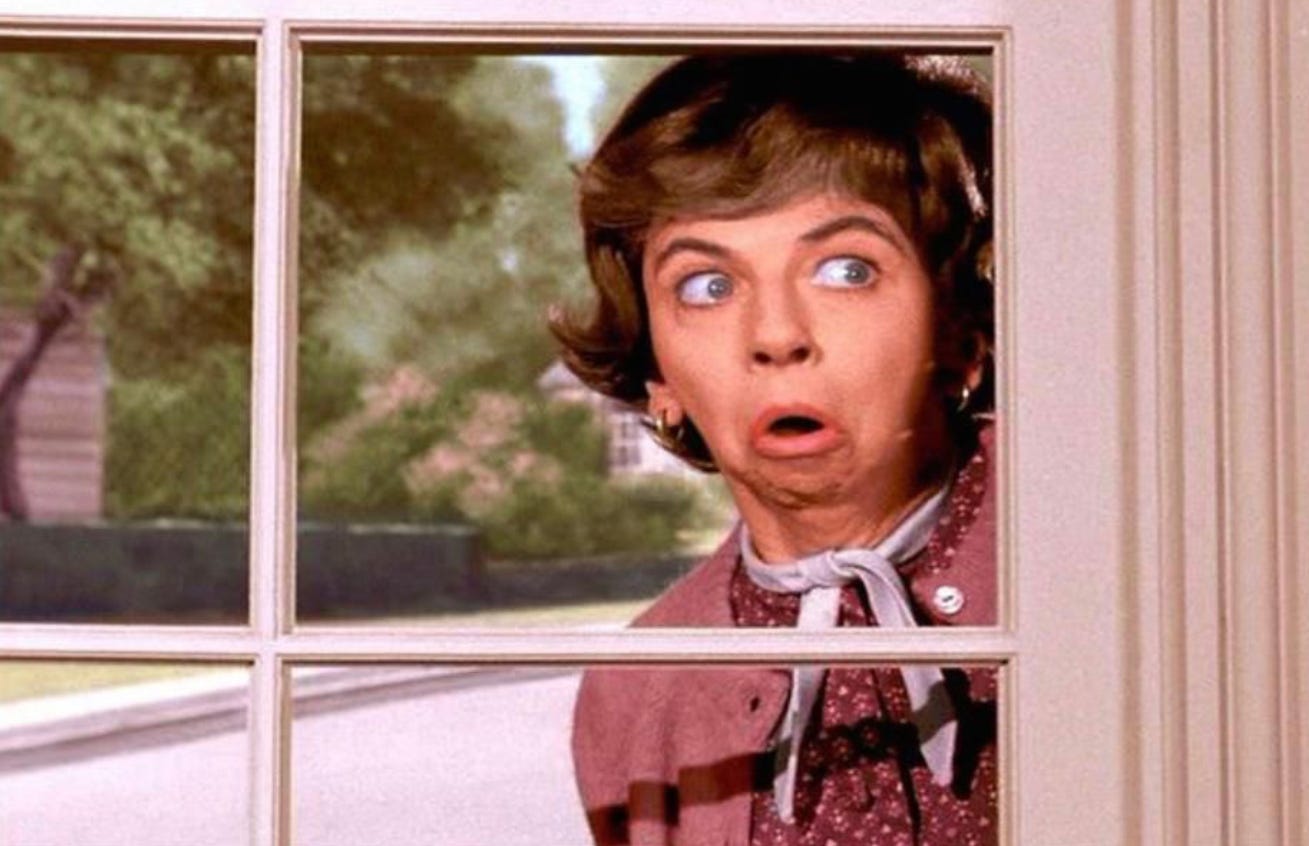
In our society the need for community awareness to stop crimes that would impact many people has become very important. If we spot a suspicious bag left on a train we’re encouraged to report it to the authorities. Campaigns such as, “See Something, Say Something, launched by the Department of Homeland Security in July 2010 encourages people to speak up about terrorism-related acts they see. According to a study done by San Jose State University, the campaign is responsible for stopping between 10 percent to 14 percent of attacks.2 Why is it so low? My guess is that there are several reasons. First, people are oblivious to to their surroundings. How many times have you driven or walked the same route and not noticed a poster or sign that’s been there for years? Secondly, people don’t want to get involved. We don’t have the time it would take, nor the desire. Thirdly, people don’t want to be pegged as a snitch, especially if they are wrong in their initial assessment of the scene. I’m sure you’ve all heard the saying, “snitches get stitches”. And finally, people don’t want to be labelled as the neighborhood busy-body, the “Gladys Kravitz“3 of the block. Those are the neighbors who see and report everything, the “eyes and ears” of the block who know everybody’s business all the time.
I am not advocating for this book, just giving you a link to it if you want more information about it. Here it is: https://www.amazon.com/Snitchy-Witch-Frank-Sileo-PhD/dp/1433830221/
https://homelandprepnews.com/stories/31768-mti-examines-effectiveness-of-see-something-say-something-programs/
A reference to the nosy neighbor in the 1960’s tv show “Bewitched”. Gladys always looked out the window just as Samantha, a witch who lived in the neighborhood, performed some sort of magic. No one ever believed anything Gladys said, they all thought she was nutty.