
What?
Where do these expressions come from?

Language is very interesting. Where do words come from? Where was a specific expression originally used? And what does it even mean?

Etymology is the scientific study of the origin and evolution of words semantic meaning over time. Huh? In simpler terms, it is the history of a word shown by tracing it or its parts back to the earliest known forms and meanings both in its own language and any other language from which it or its parts may have been taken.1 Etymologists determine word origins by comparing those words across similar languages. This comparison can lead to figuring out where the word originated and which other people borrowed and/or modified it. Etymologists can also trace expressions that we use today back to their original roots. Some of these expressions become part of our normal, daily conversation. As such we never give them a second thought about their origin or actual meaning. I started thinking about some of the expressions we use, thinking that several of them seem so strange to me, and decided to look into the origins of some of these.
1. “From the get go”
According to the website English Language and Usage Stack Exchange, here’s the explanation: From the git-go," (or "get-go," as it's slightly more commonly spelled), meaning "from the very beginning," appears to have originated in the vernacular of American Black English. The earliest record of the phrase is from 1966, when it appeared in a story by Toni Cade Bambera, a writer, civil rights activist, and teacher, whose fiction is set in both the rural South and the urban North. How long the phrase may have been used in speech before 1966 is impossible to say. A much less common variant is "from the get," which was first recorded in 1971.2
Sample usage: “I knew that the hike was going to be messes up from the get go, everyone was wearing flip flops. And I was right, the guy in front of me had his flip flop break after just 20 steps, and he twisted his ankle. I didn’t feel sorry for him.”
2. “Not for nothing, but…”
This expression actually means “for a very good reason”. The origin is the late 16th century from British and American English. A famous work it appears in is Shakespeare’s Merchant of Venice, and has been in use ever since. However as a New York area colloquialism, it only goes back to the early 20th Century. This expression is used when what is about to be said or done has a cause, a purpose, a reason, or a use. It can be used to soften the blow of a comment or remark that would normally be offensive or come on too strong. It can introduce a significant remark or a piece of advice.3
Sample usage: “Not for nothing, but what’s with your hair color? And is that black dye running down the side of your face?”
3. “Darby and Joan”
I’m not surprised if you never heard of this expression. I’ve only heard of it because I subscribe to Acorn, a streaming service that shows British and Australian tv shows. I’ll admit that I have to put closed captions on when I’m watching these shows because even though I lived in England for five years, at times I still have trouble understanding what they are saying. Anyway, there is a show on that channel called “Darby and Joan”, and I assumed it was named that for the two main characters. They are two middle aged people who meet when Joan runs Darby off the road. In the first season they become friends and have adventures together. Interested in finding out if there will be a second season, I did a google search. And what came up was an explanation of this term, which means, “a happily married elderly couple who lead a placid, uneventful life”.4 One website says it originated from an 18th century song in which the couple was mentioned. Another says it was first used in a 1748 poem. There’s even a painting of the couple from 1890 (see below). After WWII ended, Darby and Joan clubs were established so that middle aged people could meet and socialize.5 In the show the main characters do not lead an uneventful life, otherwise it would be a pretty boring, shitty program.
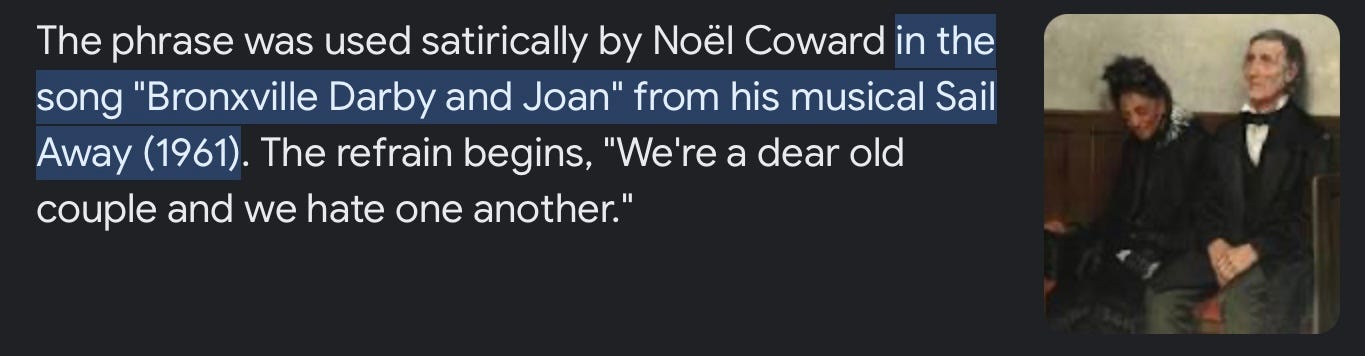
Sample usage: “Bob and Alice seemed to hardly leave each others sides for the first few years of marriage. I would have guessed they’d become a real Darby and Joan if they hadn’t gotten divorced once realizing they both liked other partners so much.”
4. “Shit-faced”
I bet you’ve used this term before to described someone who’s had too much alcohol. Or maybe you’ve used the term to describe a person who did something stupid or wrong. If you look it up on the internet, you’ll find an entry from Merriam-Webster which says shit-faced is an adjective that means “very drunk”. But where did this term come from? It’s thought to have originated with beat poets, with college students, or even with writers like Ernest Hemmingway. Some website will also tell you that the term originated in England when people would dump their chamber pots out the window onto unsuspecting dunks. If the drunk happened to look when the waste was discarded, they would get hit in the face with it, hence they would be literally shit-faced. This last explanation of the term is gross and I refuse to believe it. Instead I’m going with this explanation: shit-faced is an old Scottish term used to refer to children that did something wrong. Since kids have little faces and “shit” was a bad/dirty thing, calling a kid a shit-face expressed your disgust with them. If you really want to read more about the possible origins of this term and how they corrected the Oxford English Dictionary, check out this article on Slate.
Sample usage: I just stepped on one of Marvin’s legos again. I swear I’m going to throw every one of that little shit-face’s toys away if he doesn’t put them away.
5. “It is what it is”
Coined in 1949 in an article by the Nebraska journalist J. E. Lawrence, the term was a summation of what life was like for people in that part of the country. Farmers faced a tough life and numerous hardships to ensure success. Lawrence wrote, “New land is harsh, and vigorous, and sturdy. It scorns evidence of weakness. There is nothing of sham or hypocrisy in it. It is what it is, without apology“.6 The term is used to sum up a situation that cannot be changed. Since 2000, it’s been used in more and more situation, including sports (especially after a loss), politics, business, pop culture (such as the 2014 movie of the same name), and just about anyone who realizes they need to accept the reality of a bad situation that they cannot change. A former co-worker of mine once told me how much he hated this expression. Did he really hate the expression, or was it the dread and despair he felt knowing a situation sucks and there wasn’t a lot he could do change it? Next time I talk to him I’ll find out.

Sample usage: My little dog Dexter had dementia at the end of his life. I’d often find him standing in a corner, just staring at the wall as if he was lost. I could do nothing to help him, it is what is it.
And finally…
I’m going to end this here, even though I know there are so many more expressions used daily that cause me to say, “where did that come from?” If I don’t I’ll be writing this post for the next several years.
Additional thoughts
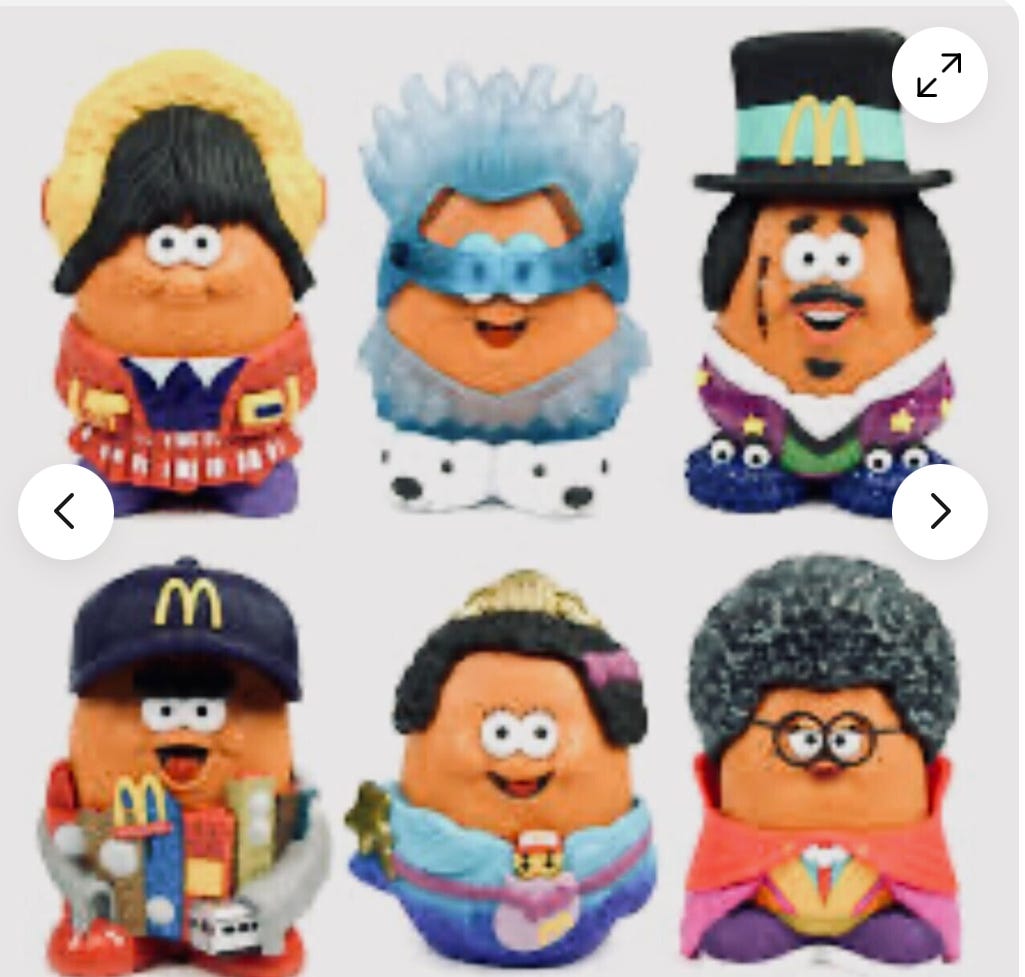
Have you seen the commercials for the Kerwin Frost Box, the adult happy meals being sold at McDonalds? You can get 10 chicken nuggets or a Big Mac, fries, a soda, and “an iconic collectible McNugget Buddy”. Expect to pay at least $10 for this feast.
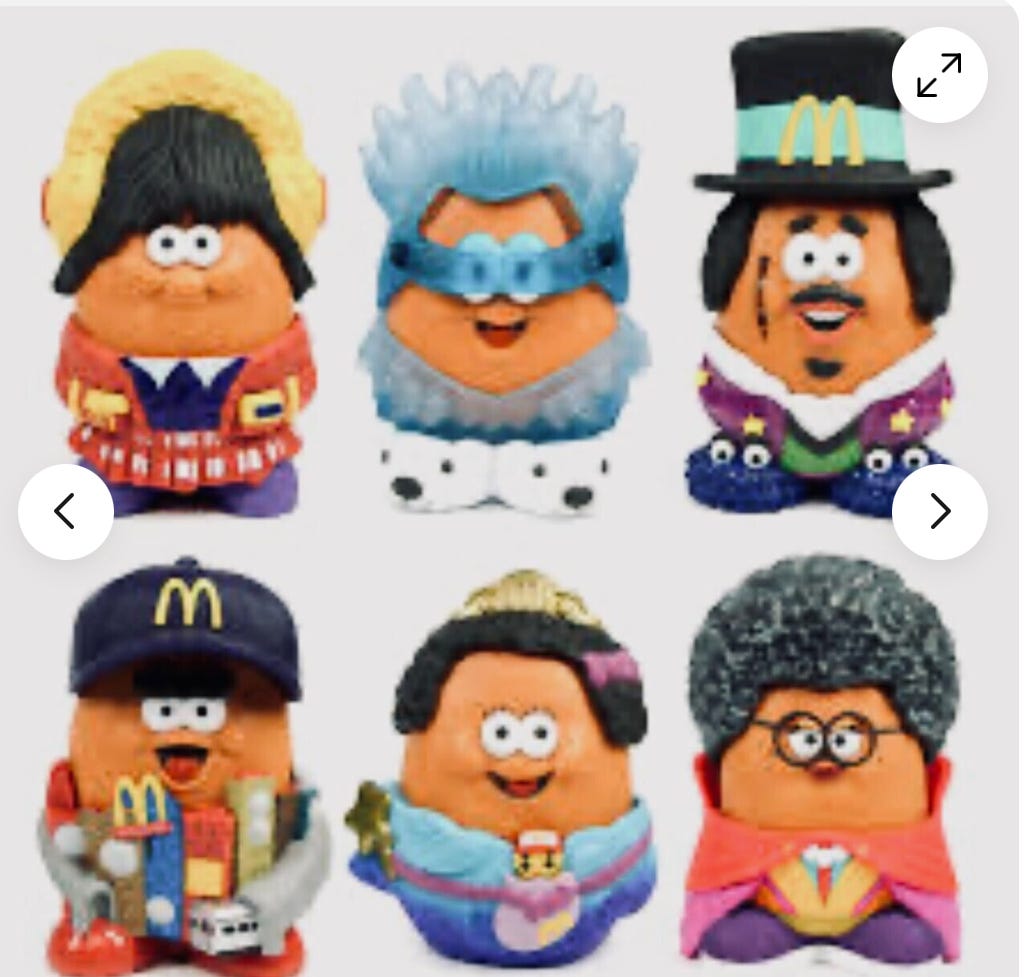
Here they are, the McNugget Buddies. On eBay now, price is $99.95 for the set. You know you want them! Book recommendation - The Maid by Nina Prose. The novel is about a young maid in a NY city hotel who finds a dead man in his room and decides to solve the crime. The characters are interesting, it’s worth checking out. Prose recently published a second novel in this series called The Guest. Both are available at the public library.
The winter solstice will occur on Dec 21, 2023. And that means it’s the shortest day of the year in terms of daylight. And that also means that each subsequent day after Dec 21 will have more daylight time. In case you don’t know, the winter solstice (also called the hibernal solstice) occurs when the Earth’s poles reach the maximum tilt away from the sun. So if you dislike days with less daylight, hang in there, change is coming soon.
Merriam Webster; https://www.merriam-webster.com/dictionary/etymology#:~:text=%3A%20the%20history%20of%20a%20word%20shown%20by%20tracing%20it%20or,parts%20may%20have%20been%20taken
English Language and Usage; https://english.stackexchange.com/questions/335638/where-does-get-go-come-from
Rolls off the Tongue; https://rollsoffthetongue.tumblr.com/post/619040382405230592/not-for-nothing-idiomatic-meaning-what-is-about
Dictionary.com; https://www.dictionary.com/browse/darby-and-joan#
Wikipedia, Darby and Joan: https://en.wikipedia.org/wiki/Darby_and_Joan
Dictionary.com; https://www.dictionary.com/e/slang/it-is-what-it-is/#
Thanks Suze, Merry Christmas to you too.
Hey Mindalah, thanks so much for being my proof reader and correcting my mistakes. I must have been shit-faced when I wrote this. I miss you too. Every once in a while I come across the pics of us making grilled cheese sandwiches at 47 and I remember how much fun we had. Enjoy the holidays